
Ice Dams, Bad Installs, and Why the Blower Door Is Non-Negotiable
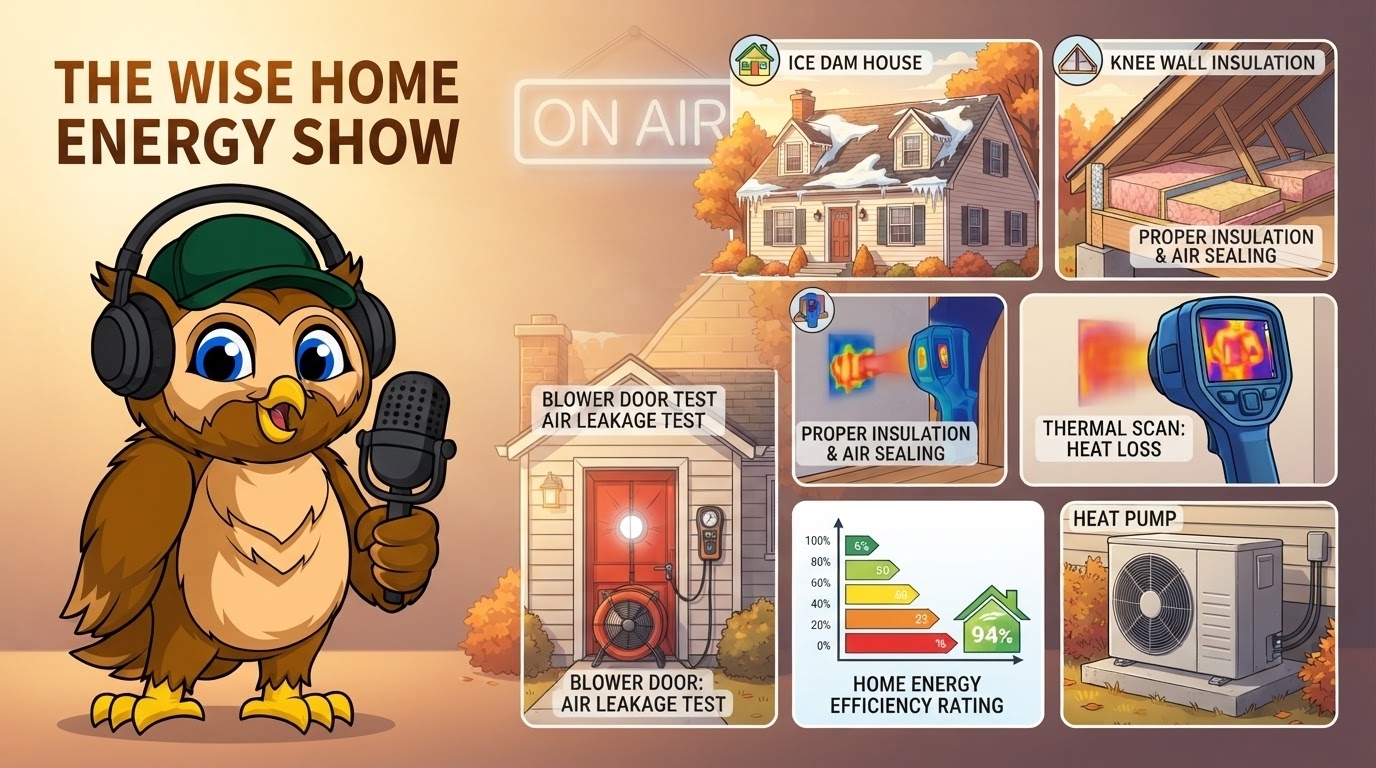
Jeff Flaherty opens with a Cape Cod ice dam call where the roofer and mason both pointed at insulation before anyone even looked at the attic, then turns to a homeowner who had a major franchise inject foam into his walls, got 60% coverage, no blower door, and neighbors asking why his bills didn't go down. The company's answer: there's no way to fix it. Jeff also walks through a contemporary home with skylights and a valley roof where a new roof isn't going to solve the ice dam, a heat pump quote that went sideways when the homeowner wanted to match his old AC size without a load calculation, and why the industry habit of sizing equipment off the existing unit is just throwing a die and calling it engineering. Plus why utility costs are heading in one direction regardless of politics, and why a balanced approach to fuel types still makes more sense than going all-in on either one.
Transcript
This podcast is brought to you by Open Door Mission, restoring hope and changing lives. OpenDoorMission.com. Well, look at the time. Here comes another Wise Home Energy Show on, the Voice of Liberty, WYSL,
WLEA. Pure energy. Yes, indeedy. And here he is, Mr. Pure Energy himself, Jeff Flaherty. Hey, Bob. I appreciate that energetic introduction.
We're all about energy here. Let's, uh, let's expend some energy so we can help people save some energy. Love that. Yeah. I like the way you think. That's the, that's the time. to do it, and the place to do it is right here at the Wise Home Energy
Show. So we're, uh, leaves are changing and, uh... or, uh, they're, they're a little late, but, uh, we're sort of getting into that fall season now that the, uh, Labor Day holiday's over and we're starting to get those calls about ice dams. Uh- What?
Already? Yeah. Yeah. They're, they're, they're starting to think, "Oh, boy, I've let the whole summer go, and now we wanna talk about ice dams." And it's, uh, it's time to, uh, to really make the move if you're gonna do anything about, uh, the ice dams because we get very busy, uh, fixing homes.
And, uh, we had a customer recently who called, and they were a little ways away from our, uh, main office and, uh, they, they had a large Cape Cod that they, uh, had some ice dams. And so we, we don't really wanna run right out to homes. We wanna f- get some information.
And so I said, "Well, if you could just send some pictures, uh, I can probably figure out the square footage from online and, and give you some, some solutions and some ballpark prices so we don't have to waste each other's time." And, um, she said, "Well, uh, though the attic, it's hard to get up there." And I said, "Well, you should have side knee wall attics." I said, "Uh, you know, the, the top attic, I sort of know what that's gonna look like.
I wanna know what your knee wall attics look like, and I wanna know, in a Cape Cod, specifically if you have drywall or if you have something other than drywall that isn't an air barrier."
So knotty pine paneling, uh, one-foot acoustical tile, all that stuff will come into play.
And, uh, she came back and said, "Well, you know, I had a roofer out, and I had, uh, a mason, uh, person out, and they said it was, uh, the ice dams was not those issues. It's insulation." And I said, "Whoa." Oh. Have we, have we heard this one before? I said, "It, it most definitely is insulation and air sealing," you know? So kudos to the roofer and to the ... Yeah. Uh, it's, it's generally not gonna be your roof. It's not gonna be your chimney. It's not gonna be your gutters. It's not gonna be your neighbor's dog or cat. Uh, it is related to snow. I guess you could blame
Mother Nature, but it is the melting of the snow when the temperature is below 32 degrees outdoors, and that melting is from inside the home.
So, uh, y- she sort of lost contact with me and didn't really, uh, follow up, but I really wanted to tell her it's gonna be probably in this
X to Y range of dollar amount, and if that seems reasonable, then we can drive out to your home. Because in this day and age, uh, time is money, and why should I waste your time to climb up into your attic to tell you a number that was never on your radar?
Uh, so we, we like to save time like that. I mean, estimates are... We call them free, but are they really free? I mean, somebody is gonna have to pay for that time. If you're doing three estimates per home and only one person wins that job, then two of those estimates, those companies are gonna go charge someone else that money. So we try to s- save on that money, and we'll investigate a little bit about what the customer needs and then go with the no-cost energy assessment that the state has, where they'll pay us a little bit and we're able to, um, you know, charge, uh, the state to give some base, uh, information.
And that's, that's really the approach we wanna do. We wanna, we wanna figure out what you're looking to fix. And, you know, some people that, that's not a fit for, and that's fine. We're not, we're not gonna be a fit for everybody, right? I mean, some people wanna go, uh, you know, bowling, and some people wanna go to a baseball game. And so we, we sort of wanna find out what your desire is, and then, and then we'll see if we have a solution and a path forward for you. And because we see a lot of heartache, Bob. That's, that's the frustration.
And, uh, a recent call last week where the gentleman called and said, "Do you have a vacuum to vacuum out my attic? I don't want you to re-insulate it." So that, that was a call. I said, "Well, let... I wanna, I wanna talk to this person." And, "What's going on?" "Well, I had the home insulated a year and a half ago, and I found out they didn't air seal the attic."
"Okay. All right. Well," "So if I vacuum it out, what's gonna happen?" "Well, they're gonna come back and, and air seal and insulate." "Okay. You're gonna trust them this time." Um- Why wouldn't, why wouldn't they vacuum it out?
Well, they didn't own a vacuum. Oh. And- Well, all right then ... and they're a big franchise- Oh ... uh, you know, that has a very patriotic name.
Uh, and, and I'm thinking, "How do they not have a vacuum?" Like, how do you, how do you go to all their jobs and do a good job? I was gonna say, that part of their, part of the, part of the gig, isn't it? The- That's what I would think. And so, and so, you know, when you send that person up into the attic, uh, you know, some people have bad days. Some people have little training.
Uh, that's why we use the camera to take pictures and document the work we're doing pre, during, and post. But then he got into the walls and he said, "Well, they put insulation in the walls, and it was an injection foam, and it didn't," um-
It only covered 60% of the wall space. And I said, "Well, that... What are they gonna do to fix it?" And he said, "Well, they've talked to the corporate office, and there is no, no way to fix it." Oh.
And, you know, he said, you know, "My neighbors ask me, 'How did, how did it go? Are your bills down? Was it-- Is it comfortable?'" And he said, "No, it's not." And I... You know, that stuff just drives me nuts because it, it's terrible for the industry. So, so I said, "Bob," as you can imagine- "... did you get a blower door test?"
And he said, "No. No, they didn't." It was through a rebate program. He said, "No, they didn't do a blower door test because of some asbestos in some tiles in the basement." And I almost jumped through the phone
'cause I said, "No, you're kidding me." So when you get to a 1950s, uh, 60s-built home around here, down in the basement you'll see these finished, uh, floors or the, the basements with the floor finished with a tile.
Some homes I always admire because people will make shuffleboard courts out of them, you know, tend to be more in the Cape Cod-style homes with a little bar down there. Well, nine-inch vinyl tile or linoleum tile, whatever it is, had asbestos in it back in the day. Mm-hmm. It is bonded beyond belief.
Um, uh- So it's not, as they say, uh, fricative? Is that what it is? Yeah, friable. It is- Friable. That's right ... freaking friable. Yeah. Yeah, yeah. So it is not that. I would think at some point in the house's life somebody put a fan on the floor. This fan goes in the front of your, uh, uh, in your front door and pulls in air from the natural leakage spots.
I cannot think that there'd be a lot of natural leakage spots six feet under the ground at your floating slab.
I, I can't... If this person is saying this, legitimately they should get out of the industry. It's an excuse. It, it- If they're saying it 'cause it's, they don't wanna be held accountable, they should get out of the industry. And I, at that point I said, "I--
This is not a good investment of my money, uh, to come out and do a break-even energy audit. I would like you to sign up for this energy audit, and I'll come out and we'll do the blower door test. You need to know data before you have them come re-insulate the home." And I said, "I don't, I don't know if we'll have the time to come vacuum out your, your home. Uh, we'll see what happens."
Uh, but I also said, "You should call the rebate program and notify them of what has taken place." Now, the rebate programs typically every year will, uh, do a quality assurance visit. But I said, "You should put them on notice.
You know, maybe this company's getting a lot of complaints." Um, but that stuff is what is, is driving me nuts because there's bad actors in every industry.
Uh, but i- if the clients, the customers don't know what is supposed to take place in their attic, what this blower door is, how much it should come down when you do this work. And for this gentleman,
I don't doubt that his bills didn't go down and his comfort didn't improve because he paid a lot of money and didn't really get any work done. And our value is... You know, he said, "I really want R-49 up there." Our value is... Our value is as good as the air sealing and the thir-- uh, the air barrier of the, of the home. And so if you insulate without, uh, air sealing, y- you're not really doing much. I mean, there are times you would insulate without air sealing, and the example would be a basement block wall.
The block is, is probably already, uh, pretty airtight. The top of the block where it's open is not. But that would maybe be an instance where you wouldn't expect to get some, some air sealing benefits out of that insulation. But most other insulation, uh, installations should get a reduction in blower door leakage. And that stuff, it, it's really... It, it scares me. I wish we could just, you know, flag all these contractors, uh, get them thrown out, move them off to a different industry. I don't know what it would be. Uh, something like tree cutting where- ... if they're doing it poorly, it, it harms them and maybe not so much the next person, you know? Uh, but this is just, um... This-- I always say there's a difference between bad work and fraud. Mm-hmm. And it's hard for me to tell after the fact, um, ignorance of your trade.
So those are the things that we, you know, certainly try to highlight here, is that this blower door, uh, you should have this done so you have real concrete data.
I mean, I, you know, over the years, uh, you know, get a physical occasionally and some blood tests and somebody calls you and talks to you. But now with it being online, and you can see it and see the chart and go revisit it, uh, to me, that's really interesting data that you can either, if you're modifying with exercise or diet or medicine, you can see if you're making the improvements that you wanna make. And when we're skipping the blower doors and we're just looking at the utility bill a year later, it's no doubt that the utility bill is, is gonna be the same, or it'll be higher if the temperatures are, are different that year. Yeah. But it's, uh, it, it's frustrating to me, so. Well, uh, and, and plus for Wise Home Energy, you, you wanna be careful about, uh, inheriting a, a situation, a job that has been botched or has been, you know, where the customer's been defrauded. Yeah. Yeah. And, and we, we get called to clean up some, uh, jobs from some people in the, in the program and, and I had one recently, and the, the program said, "Well, there's this budget." And we went out to the home, and I... And, and I knew the contractor, and I said, "Have you seen the pictures of this job?" I said that, you know, "Would, would you like to learn a little bit?" Because-
The defining of the thermal boundary is, is, um, I got a head-scratcher here. So, um, that is one of the things that, uh, professionals should be able to do, is tell you where the thermal boundary is.
So the weather boundary is the roof and the exterior walls. We want that to shed water, but it's not necessarily, or most of the time, the thermal boundary. The exterior walls are, but the roof might be, um, just the weather boundary and then below that, when we get the, uh, ceiling to the l- living space, that should be the thermal boundary and the air barrier all in alignment. And, you know, I asked the customer, the Cape Cod style home,
"Did you have..." And, and she really just thought we should just fix this little area that wasn't done. "Did you have ice dams last year?" "Yes, massive ice dams."
Mm. I said, I said, "Ma'am- And wasn't that what they called a-- Wasn't that the original- Yeah ... reason for this, this renovation? Yeah. Well, it was a grant program, uh, so it was subsidized. And I said, "Ma'am, I, I gotta talk to the program because I can't park my truck in that driveway and be the last one to roll out and, and you have massive ice dams hanging on your roof. I can fix this. I've looked at your house. It's gonna be in-depth. Uh, let me talk to the program first and, and because I cannot, I cannot have that harm my reputation by parking that truck in your driveway. I can't guarantee you'll not have any, but the blower door..." Um, so what we do with that blower door is we're, we're setting up the frame in the front door, opening up all the interior doors, closing the windows. The air is pushing out the door typically, and it's measuring how much air is leaking into the structure at a known pressure rate. So when we have these little knee wall attics and these, these upper attics, we can use a secondary pressure device, and we can, uh, measure that pressure, and we can figure out how connected it is to the outdoors or how connected it is to the indoors.
And these were terrible. These were connected to the outdoors. They're still leaking heavily. So nothing had really been quite done right, and they-- everybody thought we were just going to fix this little piece. So we have the data. Now we just have to figure out if we have buy-in from somebody to fix this. And, uh-
What, uh, kind of reaction did you get from the homeowner when you broke this news? Yeah. She was, she was pleased that I was approaching it that way, and she understood it. Um- Obviously being a straight shooter and, uh- And- ... look, you know ... and the second floor is already uncomfortable in the summer and, and cold in the winter, so that she sorta knows intuitively, but we visually look at this insulation, and we say, "Aha,
I want 6, 12, 18 inches ins-insulation." No, we want it to perform. That's what we want it to do in the end.
So we'll see where that, we'll, we'll see where that goes. Hopefully, that'll end up in the right direction, and we'll revisit that, uh, that job, uh, on this show. It's gotta almost be an, almost could be an occupational hazard for you where, you know, y-you have to disabuse people of ideas, preconceived ideas of the,
"I want, you know- Yeah ... more insulation. I, I, I want 18 inches of insula..." And, and of course, your, uh, your rejoinder is, "Well, wouldn't it be better if you were just comfortable?" Yeah.
Yeah. And you didn't, you didn't necessarily have 18 inches of insulation. Yeah. We actually have an intake form, Bob, where, um, people call up, these are the things they want.
Um, and then underneath that we have, uh, y- we call them your common issues, and these are the things that they wanna fix that we, we used to not ask about, so we didn't know they were looking to fix it. Cold, drafty rooms, hot second floors, ice dams, musty smells. Once we know that, now we can alter the, uh, diagnostics and customize the plan to them. And that has worked out great for us because we're doing quality work that solves a problem. It's worked out great for our clients because they just know upfront that we're there to fix a problem. We're not there to install a thing because the thing may not do what you have a preconceived notion that it will do. So, um, that's been...
You know, people don't like it sometimes 'cause it's a little slower process. "Hey, what? I just want you to run right out here." No. I mean, I think of that doctor's form where, uh, you fill it out, and I'm like, "I don't even know what some of these diseases are that I'm saying no to, but chances are, no, I don't have them." Um, so that's... You know, we're, we're trying to elevate the, uh, contractor base out there with that knowledge, uh, of how you, how you diagnose a home and then how you fix it. And I have a couple roofers that, uh, will refer people to Wise Home Energy, and, and kudos to them.
Um, Morial Roofing in Irondequoit and, uh, Testa Roofing out of Victor, and I, I like them 'cause they're the kinda contractors that, you know, they get a call for ice dams, and they say, "Well, it's not your roof. You have an insulation problem." Um, so they know that they're not gonna just promise somebody, "Oh yeah, I'll sell you a roof just so you can, uh, uh, just so I can sell that roof," because they know they wanna stand behind their work.
And so, uh, they will refer off and say, "This is an insulation... You should get a diagnostic. Why don't you call Wise Home Energy and start with the energy assessment?"
So, um, that's a good fit. It's hard to find, you know, like-minded people, and so for us, that's, uh, that's, uh, enjoyable to, uh, partner up with folks like that. And, um, you know, we just get these preconceived notions. I, uh- gentlemen.
I'm gonna work with one of them on a, on a roofing project where it's a contemporary home where- Wait a minute. Before you leave the Cape Cod. Yeah. Is there, is there a final chapter? The thrilling conc- I, I- ... conclusion of the- I- ... Cape Cod drama? I have a phone call tomorrow to- Ah ... outline my plan, and I'm hoping, optimistic that all parties will wanna get on board and fix this. So I hope, uh, next show we'll, we'll be able to say that this, uh... And, and concrete data.
I know we had a blower door. I can't remember exactly what it was, if it was, like, 2,800, but I'll, I'll be able to bring some stats on this. And, um, we, we wanna fix the problem. We don't want, just wanna install things, so. Hear the pragmatism, folks?
Yeah. That this is the, the, th- this is the signature of Jeff Flaherty, Wise Home Energy. And, uh, the number to call so that you won't be cold and uncomfortable and clammy and, and moist in your home is?
585-270-5836, and you can call or text that, or visit us on the web at wisehomeenergy.com. Beautiful. So- This is the Wise Home Energy Show from Wise Home Energy. Jeff Flaherty, proprietor, owner, founder, and chief bottle washer. That's right. That's right.
So the, yeah, a couple of the homes that we, uh, I've had recently with these, I call them contemporaries, where the, the front of the house has this cathedral or vaulted ceiling, usually a couple skylights, and then it goes up to a second floor attic flat. It's a Brady Bunch house? It... Yeah, I guess it could be like that. Yeah, absolutely. I could, yeah, I could wring the neck of that architect.
Wasn't he an architect? So- Yeah, that was Mike Brady. That's right. So, uh, they look cool. Um, so, you know, they... This guy called and he said, "Yeah, I got ice dams. I'm getting a new roof, and, uh, I need this area done."
And I said, "You wanna rip off the roof and foam it?" And I said, "Well, that area already has insulation." And I said, "If you don't have recessed lights, your two skylights are a little weak point, but this isn't gonna solve your problem." And I, and I always say, "Take pictures of your roof when you have snow or, uh, frost or if you have this melt early in the morning. That'll tell you where your heat loss is."
And, um, and so he wanted to take care of this then, and I said, "Well, one is you, the front part, that probably performs well." I thought there'd be baffles in it. Um, the roofer says, "No, I've done a house on that street and it doesn't have baffles." So it's supposed to in the '80s, that's what they were doing. But then there was, like, this little front garage or...
And then, then there's this big valley. So basically a valley means that the top of your home, the ridge, is gonna be four to five times the size of the little soffit area down there. So already you have this much snow and rain coverage draining down to this little gutter, um, that doesn't...
Gutters don't really have anything to do with ice dams, but in the win- in the summer, I always look and say, "How can you pour, you know, four square, 400 square foot of roof into a two-foot gutter?" You know? It's, I don't know where that architect went to school.
Uh- A tornado going through a keyhole. Yeah. Instead of a four-inch gutter, he should probably just use a road culvert with a- ... a sewer grate, you know? So y- y- y- you know. And then you're not even gonna be able to soffit vent that. It comes down to nothing. So I'm, you know, I'm, I'm consulting on it saying, "If you're getting a new roof, get some edge vents over there. But your problem is up top. That is where your heat loss is typically gonna be. I haven't done a diagnostic on your home. I would advise getting the energy audit, the di-" It's, there's nothing wrong with sprucing up your baffles and your soffit vents when you're getting a roof. There's nothing wrong with that.
That's prudent. But don't think that that's gonna solve your ice dams. So, uh, you know, it's, it's... Uh, y- and that's where we wanna work with people that wanna have a little conversation. Uh, if you've already made up your mind, then that's your design. You're just asking me for a price for that design. And, you know, I, I had a, a... Recently, a guy came to and called and said he wanted heat pumps.
I went out to the home. He wasn't there. His relative was there. I said, "What are you looking for?" He said, "Well, I want a ducted heat pump to replace my furnace, and I want a, a single head down here in the basement." I said, "Okay." So I emailed the guy. I said, "Your ductwork looks really small." I didn't meet him, and I said,
"What, what are you looking to do here?" I said, "You need a heat load calculation. We need to find out what the home needs." "Yeah, I just want a heat pump. Um, I'm involved in this program. Uh, I just need a price." I said, "Okay.
Here you go." And he comes back and he says, "You, you recommended a two ton heat pump. My air conditioner is a two and a half ton." And I said,
"Let's refer back to my email. Your ductwork can't handle that. So I'm just telling you visually from my free estimate,
I don't think it'll handle that. We would need further investigative diagnostics." And, uh, I said, "We would, we would charge for that, or you'd have to at least do an energy audit for us to get a little base understanding." And, and he said, "Well, I'm going for this grant program. They've already assigned a contractor." And
I said, "Okay." But, but the mindset of go out and read the label on your furnace or your air conditioner, and that's the size of equipment I need for a heat pump, which is a different technology, w- who... We don't know who designed that, and we, we pretty much, you know, that person threw a die out on the road and it flipped over, and then when it hit three ton, that's what he installed.
So why would we, why would we say yes? We, with that guy 20 years ago, he knew what he was doing, you know? He had a couple packs of Pall Malls and maybe it was a Friday.
And, um, you know, we, we just... So we now have better science and we, we look at things from today's standpoint
Of what is right for the home and how is that gonna make a c- comfortable, uh, system? How is that gonna make a quieter system? And so we're, we're not for everybody.
Uh, but, you know, we, we like to have a conversation and see what your goals are and, and see if we can come up with a solution for you or point you in the right direction, you know? It's- Yeah, and if, if, if you're results oriented and you're focused on being comfortable in your home, uh, sometimes you have to let these guys do their job. That is the important thing. Yeah. It's... And we can have talks about it, and we can guide you to some, uh, educational, uh, you know, mediums, this show being one of them. They're all archived, so we can, uh, go back and listen to these shows.
We, uh, try to put a lot of content on our website where you can really go through some sort of generic pricing calculators and get some ideas. It's not the end all be all, but it'll just get you in the ballpark.
And, you know, the truth is, electric and gas, uh, that's gonna be going up, right? With these data centers, even if the data centers are banned in New York, if they're putting them out somewhere else, you're gonna have the talent that would be here moving out there to build those. Uh, and really I just stumbled on the fact of the gas lines that, you know, they only have so many years of life, so sooner or later they have to upgrade the gas lines, and the cost to upgrade the gas lines these days is a heck of a lot more costly than it was 50 years ago, and those costs are gonna all be passed on to us, so. You never know, politics could change in New York State. It's possible. Doesn't, doesn't look likely right now, but if all of a sudden politics change, maybe all this, all these restrictions and, uh, and crazy strictures and whatnot will, uh- Yeah ... will go away. Well, you don't want all your eggs in one basket, that's for sure, right? I mean, we, we have the Navy, the Army, uh, the Air Force, uh, so- And the, the Guardians. That's right. So we, so we have these different forces. We, we say in our, uh, retirement plan, we don't want all our eggs in one basket. And so I, I think that's the same for most industries.
We wanna have a, a balanced approach and, and, um, th- there's, there's opportunities. The heat pumps are great, uh, for comfort. Uh, who knows the price of these fuels going forward? That is, uh, for Nostradamus to know, and, and, uh, whoever is, uh, manipulating the markets and policy will, will dictate what those prices are. But, so in the meantime, if energy bills are tough or you're tired of that cold second floor or ice dams, uh, we have a proven system of testing the home, diagnosing it, and coming up with a solution to fix it. And a great way to do that is to reach out to Wise Home Energy.
Give them the phone number again, Jeff Flaherty. It's 585-270-5836. One more time. 585-270-5836. And you have been listening to the Wise Home Energy Show from Wise Home Energy, Jeff Flaherty, proprietor and founder.
And, uh, if you missed the program, of course, the podcast always available at wysl1040.com. Thanks for listening, and we'll see you again next time for another program.