
When the Magic Paint Isn’t Enough
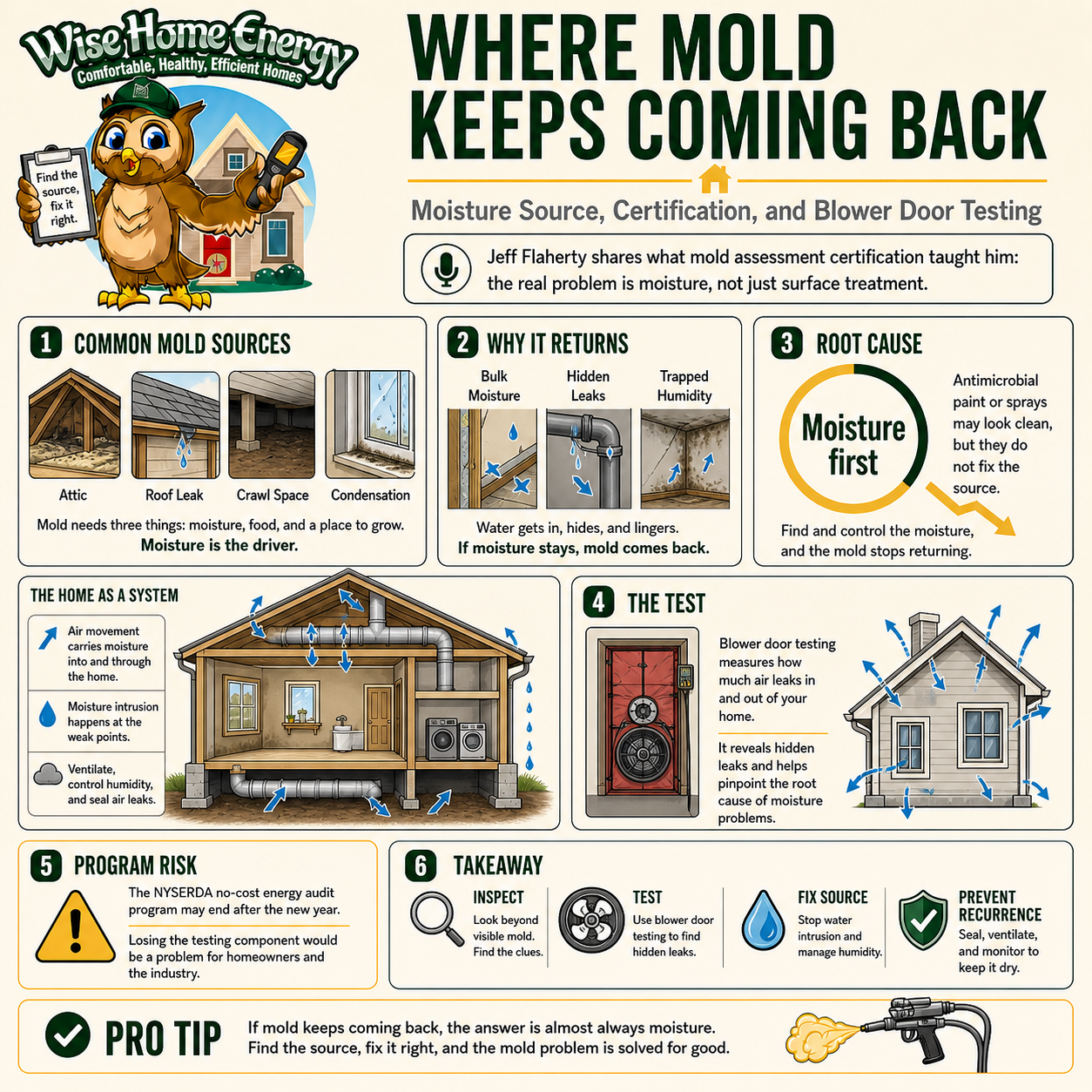
Jeff Flaherty shares a fresh perspective on mold: he just completed his certification in mold assessment and remediation, and the big takeaway isn’t what most contractors focus on. Spraying mold with antimicrobial paint doesn’t fix anything if the moisture source stays untouched. Jeff breaks down why attic mold keeps coming back, what the certification taught him about bulk moisture vs. airborne moisture, and why the blower door test is still the key to getting to the root cause. He also flags an urgent concern: the NYSERDA no-cost energy audit program may not continue past the new year, and he explains why losing that testing component would be a real problem for homeowners and the industry alike.
Transcript
This podcast is brought to you by Open Door Mission, restoring hope and changing lives. opendoormission.com. Well, hello, one and all. It's time to get energized, which can mean only one thing. It's the Wise
Home Energy Show once again with the majordomo of Wise Home Energy, none other than Jeff Flaherty in studio. Hey, Bob.
Awesome to be back here in studio. It's our once-a-month get-together. Oh, my gosh, it's my favorite time of the year whenever I'm sitting down across from the master. Aw, that's a nice thing to say.
Here, here's your, here's your 20 bucks. There you go. I appreciate it. I appreciate it. You know, we, uh, we always talk that we're, uh, and we're implying that we're saving energy, but we really wanna make homes very healthy, uh, durable and safe and that- And comfortable ... and comfortable, absolutely. And, uh, you know, I should let people know right away, urgent alert, that, uh, we don't know if the no-cost energy audit will be around after the first of the year. So-
What? Yeah, we're, we're still, uh, trying to figure it' out, but currently the NYSERDA has the no-cost energy audit, which, um, is called the Comfort Home Program, and that goes into, uh, or feeds you into a rebate program. And so that's gonna kinda get, uh, distributed out to the utilities, and, uh, the last I heard is that they weren't quite sure that there would be an energy audit, uh, portion.
So that's a little concerning. And, uh, as we talk today, um, you know, our listeners will, will find out why that really is concerning because we have to test, we have to find out how things are operating, and then we forecast how things will operate once we alter a system. Mm-hmm. Uh, I had a, a client call, uh, just this week and wanted to... Had lived in her home a long time and just had the basement cleared out of clutter of decades and, uh, asked to have insulation installed, uh, in her basement. And, uh, we offered the programs, and she said, no, she had the money for, uh, this work. And so I, I called her and I said, "Well, this isn't-- You're not taking the money away from anybody else. You're using money that you already paid for on your utility bills, so-" Which is what has me scratching my head about this a little bit because, I mean, aren't the folks paying for these audits?
Yeah. So that's, that's what I don't understand. Well, hopefully it'll get sorted out. Uh, but so this lady, uh, you know, I, I quizzed her on the phone. "What are you looking for? The rim joist?
Okay." Uh, so we would typically find old fiberglass. We pull it' out and foam it, which is going to, um, you know, leave, uh, leave less air leaking into the home.
So what, uh, what I quizzed her on, I said, "How old is your hot water tank?" And she said, "Oh, it's about 20 years old."
And so even before I drive out there, I-- do I wanna tighten up the home, which a natural draft hot water tank takes its combustion air from the basement.
So if I did a blower door test and tested the draft, I would know where that is, and then with our experience, we would know, is that gonna be a potential problem? We don't like natural draft appliances as they are because, uh, they can spill their combustion byproducts back into the home. So hopefully someday, uh, you know, I'm not a fan of banning things, but we should educate people that this is a bad device. You don't want this in your home. So without that testing, now I have to quiz them before we even come out, and we will probably at least test that hot water tank to see if, um, if, if insulating that rim joist will cause any harmful effects to the occupant. That's-- We don't wanna save energy and cause problems in the home. And, and, uh, and that's one of the things that i-it, it's hard for people to understand.
You, y- as you alter one system, you're trying to get- the desired effect, but you're going to inevitably make some other things happen, the law of unintended consequences. Mm. So- Those, those are tricky. Yeah.
So that's why we always say, "Make sure re-- vet y- your, contractor. Make sure they're an expert." I wouldn't call up my, uh, doctor and come in and say, "I'm-- I want a hernia surgery. I'd like a four-inch slice. Bl- I use my left side stomach."
You could go. to the tackle store and maybe get some fishing wire to sew it. up. I'm thinking, "I have a hernia. Can you use your expertise and do it. the way that you think it should be done?" We, can discuss those details, but maybe I shouldn't dictate how it's done. I should dictate what I'd like the results to be. Um, so that, that's really-- That's something that I think we've struggled as an industry to get across to people that as you alter systems, things are gonna change. We can forecast that if we're, able to look at the whole home.
And, uh, one of the things that I, uh, have always thought of interesting is some of the, the mold-like substance we' see in attics and, uh, uh, the, the spray paint. I call it the magic spray paint. And so
I've always wondered why they never stop the soice- source of the moisture. And so finally, a few weeks ago, I went to, uh, get my certification in mold. So I'm now, uh, certified, uh, for mold assessments and mold, uh, remediation. Wow, look at you. Yeah. And, uh- Renaissance man. And I should say that, uh, at this point, you wouldn't call us up and we' won't be doing any of that- work. I just wanted the knowledge-
Yeah ... of why this was happening and why the source of the moisture was not being addressed. So, uh, the company, uh, that, I went to was the Environmental Education Associates. Uh, it was down in
Buffalo. Uh, great organization. Andy, the, uh, I believe he's the founder. Uh, a great group of folks down there. He was an instructor for a couple of days in the class. It was a full week.
And, uh, what, you know, just- Really enjoyed it. And they, they train on, uh, asbestos and lead. And so- this, this is their forte.
Uh, we'll be sending some folks, uh, to them to get, uh, lead certified, uh, some of our new folks in the near future. So, uh, it was, it was a great week. Uh, they kept it interesting and educational at? the same time.
And, and it was, it was, uh... You know, they asked people, "Why did you take this class?" I think there was about 13 people, and I said,
"I'm curious why they spray this magic paint during the real estate transaction, and they didn't really stop the moisture source." And so other people that were in the class were, uh, folks that were, uh, already working for maybe a mold remediation company. One gentleman had just bought his house and had saw the cost of what mold remediation in the attic would be and said, "I'm gonna become a mold remediator." He thought that price was, uh, exorbitant, and, uh, that was his goal. A couple others were a big property developer that wanted to know why mold keeps growing back in their property, and then there was another one in the, from the city that, uh, worked for a big property developer and sort of the same thing. They, they wanted to know all about mold and how to prevent it and how to take care of it. So it was, uh, uh... It's taken me a long time, Bob. It's, uh, it's been... You know, if people have bucket lists, this is a work bucket list, and I, I've wanted this, and it, uh, it just allows us to offer, uh, a much better product in, in, in education on why, um, the moisture, uh, source is, is one of the critical components of mold if you don't want mold. So, uh- You gotta have moisture for mold to grow.
So it was one major thing maybe that you learned from this, uh, uh, from this educational experience about mold that you, that you never realized? Well, there was probably a lot. I mean, one of the interesting things is there's mold everywhere.
So, um, when we're, testing for it, we' have to understand that there's mold, and not all mold is, is bad. But I think I've always known that mold was everywhere because everywhere I've ever gone, people have mentioned there's mold here. And you know how I know that, Bob, is they would always say, every time
I'd show up, they'd go, "Here's a fun guy." Hey. So- Ladies and gentlemen ... I had to get that one in there. Tip your waitress. We'll be here all week. Try the veal.
So, uh, yeah, it's interesting. You know, mold, penicillin, uh, yeast for bread or- Well, yeah. I mean, some mold is your friend. Yeah. No- question. And e- even beer, I think they might use it, in beer. There you go. So, uh, yeah, that was in... How about blue cheese on a chicken wing? Um, you can have that, uh, all that, uh, Gorgonzola type cheese- Yeah ... uh, because
I, I, I read how that's made. Is that right? And, uh, uh, you would never want... First of all, I didn't, they never particularly liked it much, but once I learned about the process of making, uh, of making that, uh, cheese- Yeah ... yeah, you, uh... Somebody might be eating. Yeah, right. So I'm, I'm not gonna detail it, but, uh, y- you're better off not knowing. I heard it's kind of- If you enjoy the blue cheese-
Yeah ... you know, uh. I probably... What, what, what I do, you know, like with wings is I, I go with ranch. Oh, no, Bob. It's a safe bet. Please don't tell me. I know. Sorry. Oh, no. But no, I can't do the moldy cheese. No. I didn't know that was, uh, really a thing here in Western New York, but, uh- I know. It's a, it's heresy, but- Yeah.
So I, I wanna say, I guess the major thing I learned is... So the mold assessor, um, in New York State, it has to, be two different, uh, companies on the same job. So you can't assess the job and be the remediator. So the assessor, um, does the testing and, and testing can be just visual or there can be other tests of, uh, um, you know, air, air samples and, um, um, surface samples and sending off to labs or keeping it in-house and, and so there's different ways to do it. You write the remediation plan and you're, uh, uh, to look at what the moisture source is and recommend, um, that' you repair the moisture source if it's within the remediation contractor's expertise.
And, so that, that sort of makes sense, right? 'Cause a lot of these bulk moisture sources that I think the average person is gonna think is roof leaks, uh, flashing around windows and, doors, plumbing leaks, and foundational leaks.
So those are the bulk moisture that's getting in the home, and where I am most interested in is up an attic or crawl space where this is the ambient air carrying the moisture, then it's hitting a cold surface, it's reaching dew point, and it's bleeding out of the air basically.
And so this was touched on in the class and we'd talk of hygrometers to measure it and, um, uh, uh, you know, measuring it and dehumidifiers.
But now, we're into like really specified stuff that I have, you know, honed many years looking at. So our big thing it is in an attic, uh, that moisture is traveling through the attic ceiling through penetrations or duct work, uh, that aren't sealed. So when they, when they go up and treat the mold, they inevitably say, "Well, it's a bath fan that's not vented," or-
... they don't really go after- Simple fix, right? ... that source and because it's a complicated, um, s- discipline of, uh, building science that it's taken me years to, to hone and, and... But I always wondered why and now I know why.
Um, and, uh, and so that- As I walked out of the class, I thought, you know, we were taught everything, but people are gonna focus on here's your, uh, bulk me- moisture sources and relative humidity is what you wanna look at, so get a dehumidifier. And that's, you know, that's good enough plan. But as you look at a wall or an attic in the middle of winter and on the inside of that wall is 30 degrees or outside, and inside is 70 degrees, if we think about that wall or that ceiling, it's like a loaf of bread. Each slice, that temperature is gonna slowly change, and somewhere within that slice of bread, you're going to hit the dew point. So depending on, um, how we're controlling that moisture in the air and what that dew point is and, and so the ceiling is most important because there's pressure moving, uh, up against the ceiling.
So that part was... It just reconfirmed what I already knew, but now I know why the mold assessors and mold remediators are doing what they do. And a lot of it goes to correcting it and then maintenance, right? You, we have, you d- you've done the mold remediation, now it's up to the property owner to keep things clean, uh, so we don't have a food source, uh, keep things dry. If something gets wet, get on it and get it corrected very quickly.
I once had a dehumidifier clog in my basement, and it was hitting carpet and f- you know, four days later I came down and it's like, "The carpet's gotta go. Let's get this dried out." And, um, so tho- those maintenance things, you have to kinda be inspecting things and, and keeping up on, uh, cleaning and keeping things dry. And, uh, I think the other thing I, I found super interesting is that mold is, um...
like predates plants and animals. Uh- Yeah, it's a multi... It's a, a single cell- Yeah ... uh, critter. And, uh, it, it is, it is, it is mentioned in the
Bible. Uh, in Leviticus, I believe it's 33, and I'll, I'll paraphrase for you that they tell you to, to go and clean the mold and, um, uh, dispose of the things in a, uh, the- that are moldy and un- uh, put it in a dirty space. I guess that was a refuse, uh, center back then. But it never...
It says clean it, uh, but then if you come back and the mold comes again, it says kinda destroy the house. So- Hmm. Uh, it didn't say anything about getting rid of that moisture source. So they... We've come a long ways, uh, in a couple thousand years.
Uh, so we are focused on the moisture, uh, but I think we're still heavily focused on the bulk moisture, which is, uh... It's a good thing to, um, look at, but you also want to look at, you know, how the relative humidity is. And, and I think what I would, what I would do maybe differently is because we're in homes at different times of the year, I probably would recommend dehumidifiers, uh, more often. 'Cause we could be in a home where it's kinda dry, but maybe that's just the time of year and that was that particular day.
And when we have temperatures ranging from minus five degrees to 95 degrees in a year, we've, we've got a 100-degree temperature swing that our, uh, outdoor air can move through in 12 months. So we're gonna have, uh, a dynamic, uh, environment outside, and that's gonna affect the, the, uh, environment inside. So- So is there a, a relative humidity that you wanna aim for inside the house? Well, we... Yeah, the, the powers that be will, say
40 to 60, and there's this graph that really shows what happens when you get too dry and what happens when you get too wet. You can start creating some problems on both ends of those spectrums, but- Oh, yeah. Too dry, it starts to, it starts to dry out your mucus membranes-
Yes ... your sinuses- Yes ... your nose. Yeah. You become, you become, uh, more susceptible to illness and disease and viruses when you're too dry or too wet.
And so, uh, you really have to be, uh, cognizant of that. And some people have a system. where they sorta know exactly, right? And, uh, but then I, I tend to. say more in the wintertime that maybe 40 to 50.
And then the caveat is if you have a poorly insulated home or an area that's poorly insulated, you will have a very cold spot. So that can hit dew point a lot quicker.
So if you have unfettered air coming in, uh, or unrestricted air... So similar-- Sometimes you'll see that on a window where there's that little air leak and, and the gasket and the, and the moisture's just showing up there 'cause the cold air is meeting that, um, relative humidity and just, uh, condensing it right out. So, uh, it was, it was... I, I'm thankful that I did it and, uh, it was, it was really interesting.
I- How long was this? Uh, several days? Uh, it was a full week. I mean, the last day- No kidding ... was really more, uh, the testing. And really what there was is, like, three... It was a combination course. So there was, um, uh, a mold remediator, a m- mold contractor, and a mold, uh, assessor.
So, uh, like I said, I have the certifications. I'll keep up with the continuing education.
Uh, it was, uh... But it's more of I can use this now to educate, uh, customers on what's going on in their home. I mean, the black mold... I mean, and, and we could probably talk about this at, at other shows, but the different molds, this whole black mold, there are so many species of mold.
And then there, the, the sort of the subcategories that these species fall into, some are, uh, are gonna be worse than others. So, and that's why, you know, some people know of, like, the bats and, uh, birds when the, when the
Uh, feces are out there and the mold start growing on them, that can be really, really dangerous stuff. So, um, not- Boy, if, if, if you got bats, you, uh... a mold is, uh, probably the least of your problems. Gotta get those bats out of there. Right. Yeah. Then you got the potential for rabies and, uh, yeah, so.
Oh, yeah. Well, they're rodents, I guess. Yeah. Right? And, and so they, uh, they carry all kinds of fun disease. Yeah. So it's, uh, it's interesting. And then, you know, the other side of the fence for us on the, on the mold potential, assuming it's not a plumbing leak or a roof leak is crawl spaces. We've, uh, we've had building scientists or people that called themselves building scientists, uh, say that we should vent these crawl spaces, and so they put these vents in and code is years, uh, put it in and put the insulation on the ceiling and it's just hot, moist air and, and it's just generally not what we wanna do unless you're really by a coastal community and you've got some extenuating circumstances.
We wanna stop bulk moisture from coming in there, and then we wanna stop air from coming in there. And then the third thing you can do is, uh, you can add some heat. So if you raise the temperature, um, then the humidity can't, uh, have a, find a spot to condense, so. Or throw a dehumidifier in there is another way to do it. So those, those two areas, uh, um, are, are big.
Uh, and it, and it's really falls into a lot of what we do with infrared cameras and, uh... So that's why we recommend the energy audit. We hope it stays, uh, going forward. Uh, we're on some, uh, uh, contractor association groups that we're, uh, you know, putting our two cents in because- You lobby in a little bit? Yeah, because if people just go insulate a home, that's how this industry really started, is people would just go insulate a home and n- they would had no knowledge of a hot water tank or a fireplace backdrafting. Uh, so now we're trained in how air moves and how air moves when we heat things and how air moves when we turn on mechanical devices. So-
I'm glad you circled back to the energy audit because we were talking about it a little earlier in the program and about how the state might be, uh, uh, you know, might be taking that, uh, program away. Yeah. Uh, and how you're trying to, uh, maintain that. I, I was just curious to know, I mean, obviously each case is gonna be different, but what would the cost be if you didn't have that, you know, we didn't have that program that we've been paying into- Yeah ... and the state is underwriting these things actually with our own money.
Uh, i- if you just wanted to hire you guys to come and do the energy audit that you would do, uh, NYSERDA style audit- Yeah ... what would that cost the average consumer? So the, the state pays us, uh, $300. It, and we, we, uh, as an industry, probably think that's on the low side.
So we've sort of kept within that range and then it depends on what they want. Um, so that's kind of a base. Uh, assess the insulation levels, assess the whole home, test the heating system, the hot water system, do the m- the, uh, most important test, the blower door test. Uh, but there's other tests that you can really... You can measure each bath fan.
If you have a device, you could measure, uh, the kitchen fan if you have the appropriate, appropriate device. You can measure the airflow on the duct work. And so for us, those are tests that n-90% of contractors don't even have the tools or knowledge to do. I was gonna say, sounds like a lot of work for 300 bucks. It is. You could... We, we've talked about it in the office. You could set... And that's why we don't do those extra tests.
We almost view the initial audit as the, kind of the general practitioner, uh, having your physical. Um,
"Hey, this is, you know, this is pretty straightforward. We've seen this before. You can move. Uh, here's your, here's your concerns. You can move forward with this plan." Uh, other times we come back to the office, look at the data and say, "There's additional testing you need. Would you like to, to pay for that additional testing so we can give you, um, the proper design for your install?" And so we'll charge a price for that and take that off as a deposit toward the work so, uh- Well, that's a cool program.
Yeah. Yeah. So, uh, that's a good question, Bob. And, and, um, it, it's amazing we... I, you know, we get
QAs, uh, quality assurance visits on some of these programs, and even some of the quality assurance folks, uh, will write that they didn't do a blower door because it was hot out. They didn't do a blower door
'cause there was some mold-like substance in the basement. They didn't do a blower door 'cause there was indoor air quality problems 'cause there was cats. They didn't do a blower door 'cause the air conditioning was running.
And I thought, you know, if the quality assurance folks are, uh, kind of making up excuses to not do blower doors, then, you know, the general contractors are. So that's one of the things, uh, we recommend.
If you're, if you're doing, uh, if you're gonna have an energy audit, make sure there's a blower door test. Um, you can ask for that number right there.
Uh, any reputable company is gonna let you take a picture of that. We take a picture of it, and we'll share all the pictures that we take in the home. None of this stuff is, uh, we're trying to keep secret of it. Uh, I had a customer recently who called in who had some problems, and I said, "Well,
I can fix your home." And they had some work done, and I said, "You should go back to the, the program that you went through and go get the pre and post blower door." And, and they said that they were having a hard time getting the information. So
I said, "Well, that's, that's what we're gonna be." That's interesting. We're gonna be transparent and give that information. I feel it's theirs. So I don't know if they were having trouble trying to get it from the contractor and
So, uh, one day we'll s- we'll come up with our Bill of Rights at Wise Home Energy and show you what happens when you call us, that we're not gonna hide the information that we find. Uh, you paid for it, either through the state or directly through us.
We're gonna give you the information. You know, it ... You might not have the knowledge of how to, uh, extrapolate that and, and, and interpret it to see where the home should go, but we're gonna give you that knowledge because you paid for it. Uh, and it's something you need to make educated decision, decisions going forward, so. Sounds good. So in the time we got left here in the program, uh, Jeff Flaherty, by the way, from Wise Home Energy.
Uh, and, you know, you got, uh, roofing contractors, you've got, uh, windows and siding, uh, HVAC people, uh, and that's to be distinguished from what you guys do. Yeah. You're not the person y- y- y- you know, i- if you're thinking, well, you know, the furnace is kinda old, hot water heater's, uh, 20 years old, uh, what we were talking about a little earlier, uh, Wise Home Energy is y- you, you play in a different arena. Right. Yeah. We're, uh, we're looking at, so not only efficiency, trying to access, uh, any rebates that are available for you, we wanna look at the health and safety first and foremost, and your concerns. You know, I was talking to a lady the other day and she was getting a new natural draft replacement hot water tank, and we had installed, a heat pump.
And, she asked if we could disconnect our, um, drainage from the heat pump, similar to an air conditioner has a little drainage PVC. And I'm thinking, can't, can't your plumber do that? Is he, is he a plumber or, a handyman?
So, uh, you' know, sometimes y- you' really wanna ask the questions of who's out there, what they know, um, and, and make sure you're making not the, the cheapest decisions on price because, there's upfront price and. then there's operating costs.
And, and beyond operating costs of utility bills, there's operating costs of danger. Um, if you install a natural draft hot water tank and a bird enters that flue pipe, that, that can still operate and just backdraft into your home.
So yeah, call us up. We're gonna hope to have that energy audit past the first of the year. But, uh, give us a call or visit our website at wisehomeenergy.com and- Got a, got a sense how, how that looks? Is it, uh- I would think- ... a decent shot? I would think that they'd have to somehow. Uh, because for? us, it's
... We, we're gonna have to, do it. It's gonna drive the price up, so, um, we just don't wanna ... I've seen people put in natural draft hot water tanks, then we went up in the attic afterwards a, a year or two later and the, the chimney was gone.
It' was just, it was just- Oh, my gosh ... venting into the attic. And so- That's not good. That's the downside of not having a full inspection. Yeah. So. Uh, carbon monoxide, uh, accumulating up there. Wow. Yeah. Holy moly. Hope your CO detector's, uh, got fresh batteries.
Right. All right. Wise Home, Energy. It's the Wise Home Energy Show, and you've been listening to Jeff Flaherty, uh, the majordomo of Wise Home Energy. Uh, give them some contact information, a website and all that good stuff. Sure. It's call or text at 585-270-5836 or wisehomeenergy.com.
Excellent. And by the way, you miss the program here, it's always available anytime at wysl1040.com. We'll see you next time with the Wise Home Energy Show on the Voice of Liberty, WYSL 1050 AM. I wanna know what you're thinking.
There are some things you can't hide. I wanna know what you're feeling. Tell me what's on your mind